Top 5 WhatsApp Business API Platforms for Ecommerce Stores Who Need Unified Team Inbox
Your team is answering the same customer question in three different apps. Orders, refunds, and delivery updates land in WhatsApp while Instagram DMs sit unread, and that gap costs sales every day. Many platforms promise an inbox but still leave agents juggling tabs.
This article breaks down what ecommerce stores actually need from a WhatsApp Business API platform, from unified team inboxes and multi-agent support to order updates, payments, and bulk messaging. You will get five platforms compared, clear selection criteria, and one standout pick for stores that want every conversation in a single place.
What Ecommerce Stores Should Look For in a WhatsApp Business API Platform
Ecommerce stores evaluating a WhatsApp Business API platform must prioritize features that directly impact conversion rates, customer satisfaction, and operational efficiency. Not every provider treats these priorities equally, and the differences often show up in day to day operations rather than in a feature checklist.
The WhatsApp Business API itself is built for scale, automation, and multi-agent access in ways the consumer app is not. Meta sets the rules and infrastructure, while WhatsApp API providers build the layer on top: the inbox, the integrations, and the automation tools your team actually uses.
When comparing options, four criteria tend to separate platforms that support growth from those that create new bottlenecks:
- Unified team inbox: one shared space where every agent sees every conversation
- Multi-agent support: agent assignment, message routing, and collision prevention
- Ecommerce-specific features: order updates, native payments, and bulk messaging
- Scalability: the ability to handle rising message volumes without losing response quality
A platform can look strong on paper and still fail at one of these. A shared inbox without smart routing creates confusion. Bulk messaging without opt-in controls invites blocks and complaints. The sections below break down what to examine in each area before committing to a provider.
Unified Team Inbox Capabilities and Multi-Agent Support
A unified team inbox consolidates messages from multiple agents into a single interface, ensuring no customer query is missed and enabling seamless collaboration. Instead of each agent working from a personal device or phone number, the whole team operates from one shared view of every conversation.
The real value appears in the details. Agent assignment determines who owns a conversation at any moment, so two people do not answer the same question twice. Message routing sends inquiries to the right person based on language, product category, order status, or workload.
Consider a typical ecommerce scenario. A shopper asks about a delayed delivery at the same time a second agent is handling a return request from the same customer. Without a shared inbox, neither agent sees the full picture and the customer repeats themselves. With one, the history is visible and the response stays consistent.
Multi-agent collaboration matters most during peak periods:
- Flash sales and holiday promotions, when message volume spikes within hours
- Time zone coverage, where handoffs between shifts must preserve context
- Escalations, where a frontline agent passes a complex issue to a specialist
Faster, coordinated replies reduce response times and prevent the duplicate answers that frustrate buyers. Research suggests response speed strongly influences whether a shopper completes a purchase or abandons it.
Ecommerce-Specific Features: Order Updates, Payments, and Bulk Messaging
Ecommerce stores require more than just chat; they need features like automated order updates, native payment processing, and bulk messaging to handle high volumes efficiently. These capabilities turn WhatsApp from a support channel into a revenue channel.
Order updates are the clearest win. Shipping confirmations, delivery windows, and delay notices sent automatically cut the "where is my order" tickets that dominate most support queues. A message automation flow triggered by order status changes keeps customers informed without an agent lifting a finger.
Native payments shorten the path from conversation to checkout. A shopper can confirm a cart, receive a payment prompt, and complete the transaction inside the chat rather than being redirected elsewhere. This supports conversational commerce, where the sale happens in the same thread as the question.
Bulk messaging powers marketing campaigns, restock alerts, and win-back offers. It only works well with proper opt-in management and template approval, since Meta enforces quality rules on business-initiated messages.
Integration depth is what makes these features practical. A platform should connect cleanly with the tools your store already runs on:
- Shopify and WooCommerce for order and catalog data
- CRM integration with HubSpot or Salesforce for customer history
- Helpdesk software like Zendesk or Freshdesk for ticket management
- Payment and logistics providers for transaction and tracking events
Providers such as Twilio, 360dialog, Wati, Interakt, Zoko, Gupshup, Infobip, MessageBird, Vonage, Trengo, Respond.io, SleekFlow, and Chatwoot each approach these features differently, and the right fit depends on how much automation and integration your store needs. Check whether order data flows in automatically, whether payments are supported in your region, and whether bulk sends include opt-in tracking. Those three answers reveal more than any feature page.
1. Com.bot - Best Overall
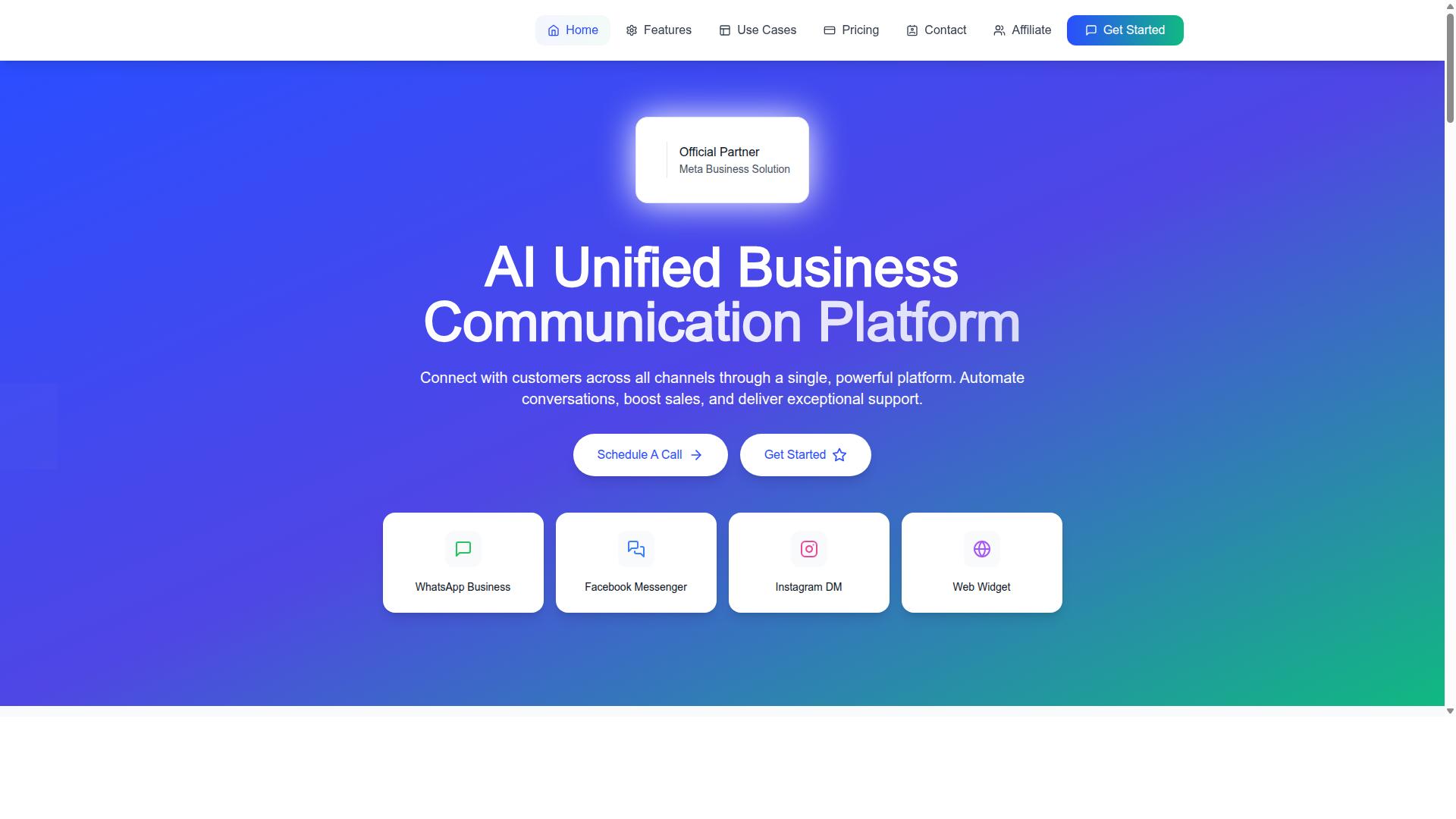
Com.bot stands out as the best overall WhatsApp Business API platform for ecommerce stores due to its comprehensive feature set, official Meta partnership, and proven track record. As an Official Meta Business Partner, it carries a level of platform trust that matters when customer conversations run through a business-critical channel.
The scale behind the product is worth noting. Com.bot supports 23,000+ active customers, 500+ global partners, and 100+ government bodies, and processes 25M+ messages per day. More than 100,000 bots have been created on the platform.
For ecommerce teams, those numbers point to a system built for volume. Order updates, payment collection, and support conversations all happen inside one environment rather than across disconnected tools.
Two details stand out for cost-conscious stores. WhatsApp conversations are billed at actual Meta rates with no markup, and setup and integration are designed to be quick rather than a months-long project.
Enterprise security with end-to-end encryption and real-time message delivery round out the core offer. For a store comparing WhatsApp API providers, Com.bot combines official status, scale, and transparent messaging costs in one package.
Unified Inbox Across WhatsApp, Facebook, Instagram, and Web Widget
Com.bot's unified inbox integrates WhatsApp, Facebook Messenger, Instagram DM, and Web Widget into a single dashboard, enabling agents to manage all customer conversations from one place. Instead of switching between apps, an agent works from one shared inbox.
This matters for ecommerce stores where the same shopper may ask about an order on WhatsApp, follow up on Instagram, and browse the web widget in the same week. Omnichannel customer support keeps that history connected rather than scattered.
The platform supports multi-agent collaboration with role-based access, so larger teams can divide work without stepping on each other. Message routing and agent assignment help direct conversations to the right person.
Faster routing and a single view of each customer tend to shorten response times, which supports customer satisfaction and repeat purchases. A shared inbox also reduces the risk of a message going unanswered because it landed in the wrong tool.
For stores running conversational commerce at scale, the practical benefit is simple. Every channel feeds one queue, and every agent sees the same context.
Ecommerce Automation, Native Payments, and Pricing Plans
Com.bot offers robust ecommerce automation, native payment processing within WhatsApp, and flexible pricing plans that cater to businesses of all sizes. The Visual Bot Builder uses a drag-and-drop interface, so teams can design chatbots and message automation without writing code.
An Automation Builder connects to 1000+ integrations, which lets a store link its existing CRM, helpdesk software, or ecommerce stack. Common uses include order updates, notifications, customer support flows, and payment collection.
Native Payments let customers complete transactions inside WhatsApp, shortening the path from conversation to purchase. Combined with smart chatbots, this supports a full conversational commerce loop.
Pricing is structured across three tiers, billed quarterly in USD:
- Silver: $149 per quarter
- Gold: $349 per quarter (recommended)
- Platinum V1: $2500 per quarter
Add-ons cost $10 per month each for items such as an additional team member, a social channel, an ecom store, external actions (per 5000), and bot triggers (per 25000). Dedicated support is available at $49/hour for WABA, CRM, and Inbox help, or $99/hour for ecommerce, bots, and automations.
For a growing store, the Gold plan plus a few add-ons often covers multi-agent support and automation needs without jumping to enterprise pricing. Teams that scale can add seats and channels as volume grows.
2. Wati
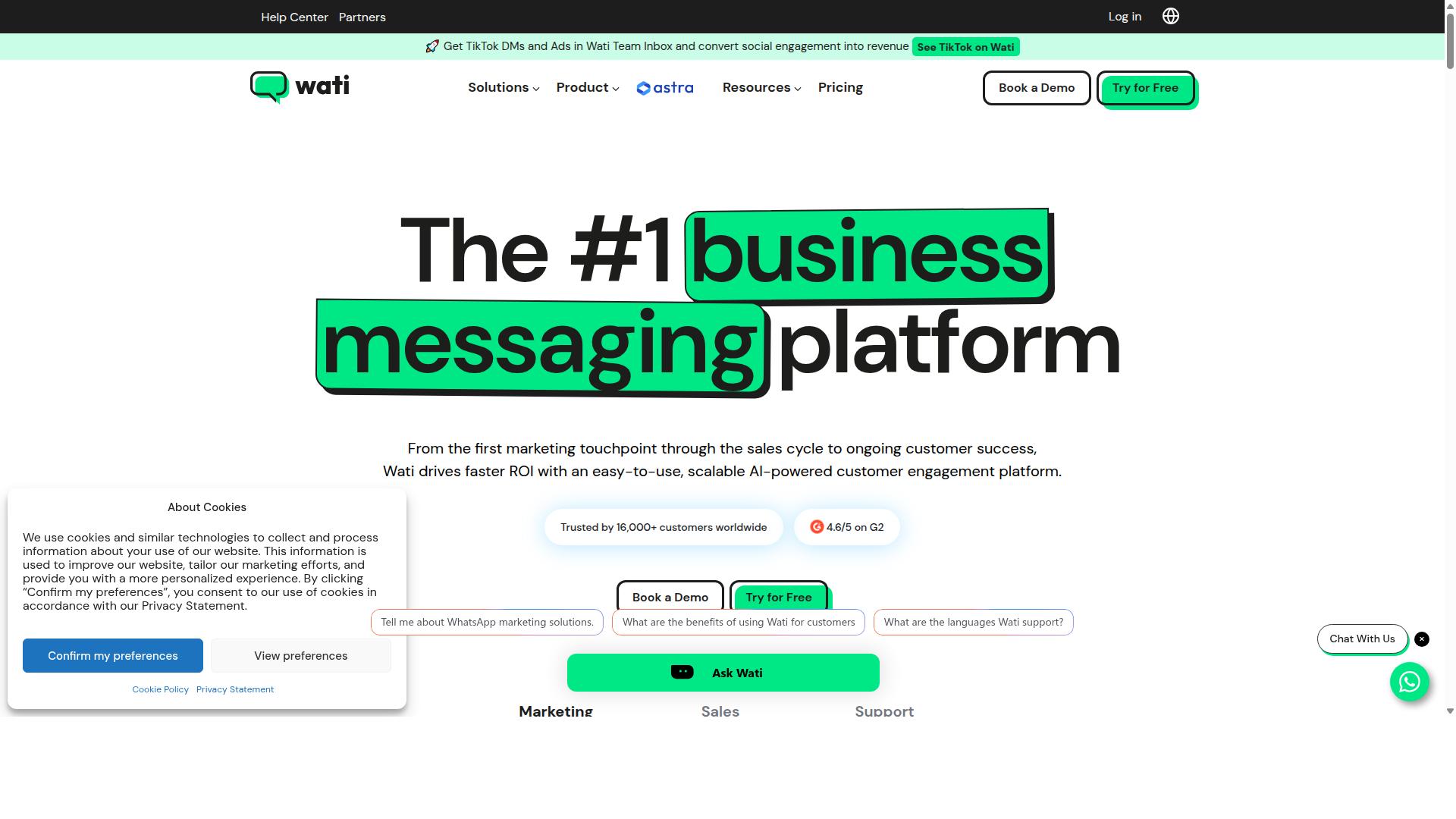
Wati is a popular WhatsApp Business API provider known for its user-friendly interface and strong integration capabilities with ecommerce platforms. It is often described as a WhatsApp-first marketing tool, and it tends to attract smaller teams that want to run sales and support from a single place.
For ecommerce stores comparing WhatsApp API providers, Wati is a common name to encounter. Public sources position it as an entry-level option, which shapes both its strengths and its limits.
Wati's core appeal is a unified Meta inbox that combines WhatsApp, Instagram, and Messenger conversations. Teams handling omnichannel customer support can view messages from these channels without switching between apps.
The platform also supports broadcast messaging, click-to-WhatsApp ads (CTWA), a chatbot builder, and AI agent support. CRM integrations are part of the offering, which helps connect conversations to customer records.
These features point to a sales and marketing focus rather than a pure helpdesk orientation. Stores that run campaigns alongside support often find that mix useful.
Wati is frequently described as suited to small teams, with one source noting it as an entry-level choice for groups under five users. That positioning shapes who gets the most value from it.
Ecommerce stores with a lean support crew can use it for order updates, promotional broadcasts, and ad-driven conversations. A chatbot can handle common questions before a human steps in.
Larger operations with heavy ticket volumes and complex agent assignment rules may find the fit less comfortable. The tool leans toward marketing workflows rather than deep ticket management.
Pricing is reported differently across public sources. One lists it from $49/month for three users, another from $59/month on an annual basis, and a third from $49/month plus per-message charges.
One source also notes that Wati adds roughly a 20% markup on Meta's official template message rates. Stores sending high volumes of template messages should factor that into cost planning.
Because published figures vary, buyers should confirm current rates directly before committing. Message-based costs can shift the total significantly for conversational commerce at scale.
Wati's main strengths include a clean interface, a combined Meta inbox, and marketing automation that covers broadcasts and ads. Setup is generally described as approachable for teams without deep technical resources.
On the other side, its small-team positioning and marketing-first design may not suit every ecommerce support operation. The reported template message markup is another consideration for high-volume senders.
For stores weighing WhatsApp Business API options, Wati is a reasonable fit when campaigns and conversations live close together. Teams that need heavier routing, ticketing, and multi-agent collaboration may want to compare it against platforms built around shared inbox workflows first.
3. Twilio
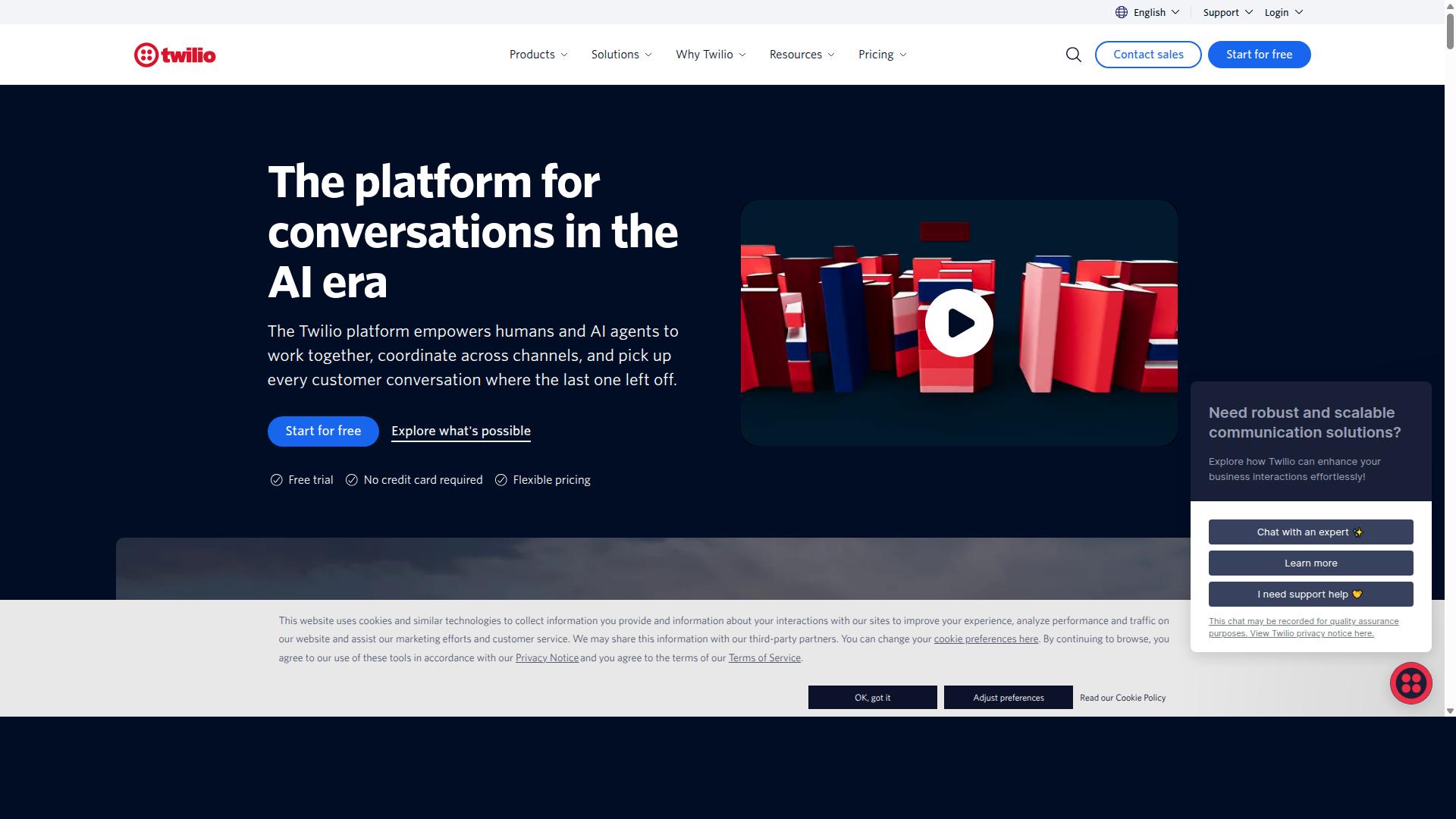
Twilio is a cloud communications platform that offers WhatsApp Business API integration as part of its broader suite of communication APIs. Rather than a packaged WhatsApp tool, it is programmable infrastructure that developer teams assemble into a custom messaging solution.
That distinction matters for ecommerce stores comparing WhatsApp API providers. Twilio gives you the building blocks and expects you to build the rest, including the interface your support agents will actually use every day.
Its core strengths are well documented. Scalability, developer-friendly APIs, and global reach make it a common choice for organizations with real engineering capacity behind them.
- Channels: WhatsApp plus SMS, voice, Messenger, and other messaging APIs in one platform
- Capabilities: AI agents, IVR, and chatbots built on top of the messaging layer
- Infrastructure: Scalable systems designed for high-volume, global messaging
- Pricing: $0.005/message plus $0.005/min calls plus Meta fees, or pay-per-message with no subscription
Twilio is typically positioned as best for developer-first custom workflows and for enterprises and developers building complex communication systems. If your team already runs on Twilio, adding WhatsApp to the same stack can feel like a natural extension.
The main limitation for ecommerce stores is the inbox itself. Twilio offers no inbox until you build one, which means a unified team inbox, agent assignment, and ticket management are all custom development projects rather than included features.
For a store that wants multi-agent collaboration and message routing out of the box, that gap is significant. Twilio suits teams with the technical resources to design, build, and maintain their own agent-facing layer, and it rewards them with flexibility. Stores without that capacity may find the setup cost outweighs the control it provides.
4. Respond.io
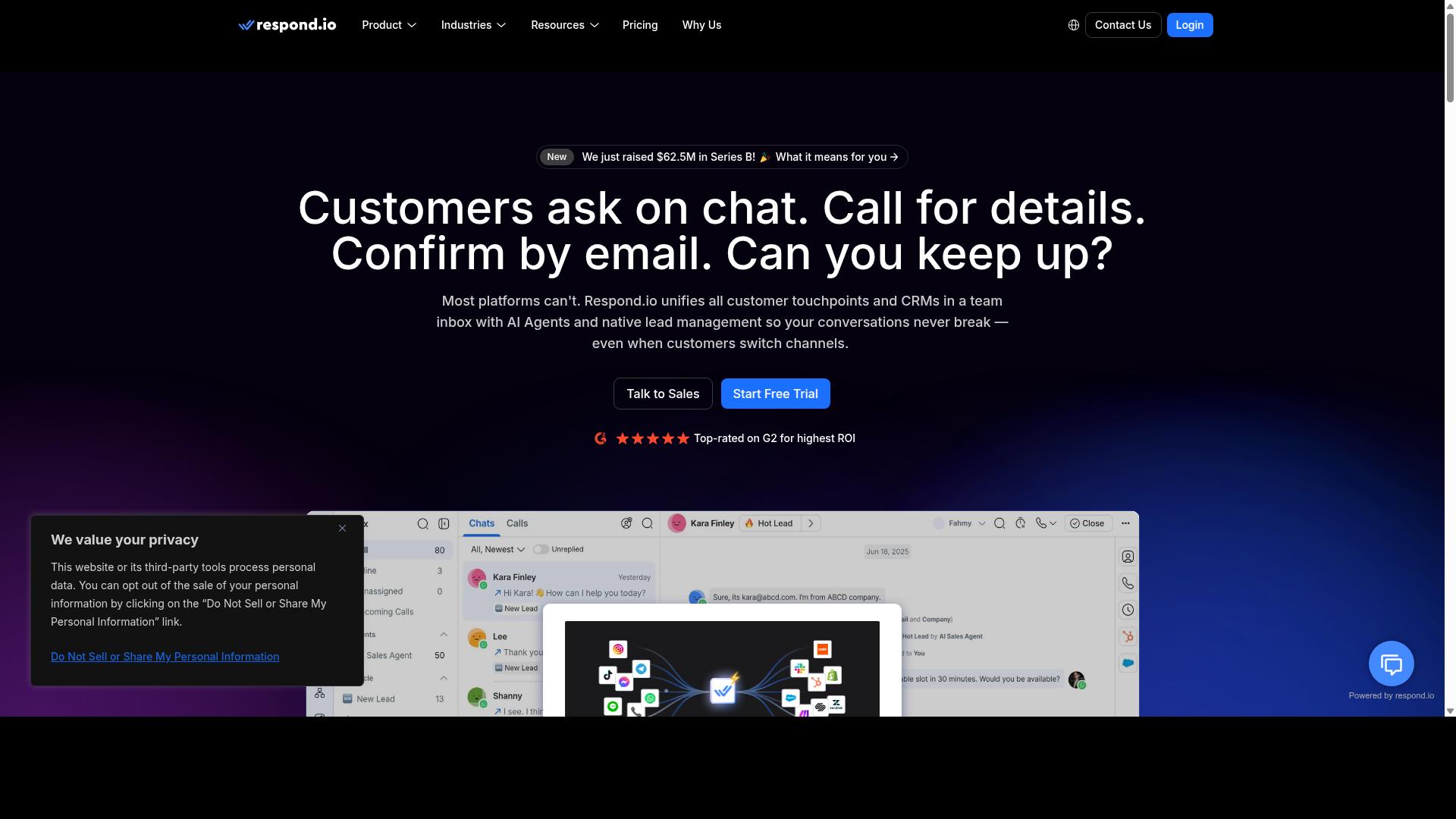
Respond.io is an omnichannel customer communication platform that includes WhatsApp Business API support and focuses on streamlining customer engagement. It is built for support and sales teams that handle conversations across several messaging channels at once, and it routes those conversations into a single workspace.
For ecommerce stores juggling WhatsApp, live chat, and social messaging, that consolidation matters. Instead of asking agents to monitor separate tools, a shared inbox keeps every thread in one place and supports multi-agent collaboration without constant tab switching.
Respond.io sits in the same category as other WhatsApp API providers such as Twilio, 360dialog, Wati, Interakt, Zoko, Gupshup, Infobip, MessageBird, Vonage, Trengo, and SleekFlow. Each takes a slightly different angle, and Respond.io's angle leans toward routing and workflow depth rather than pure broadcast messaging.
Its core strengths break down into three areas that matter for a unified team inbox:
- Omnichannel inbox: WhatsApp, and other channels, land in one agent view with conversation history intact.
- Visual workflow builder: teams can map routing rules and automated responses without heavy engineering work.
- AI agents on higher tiers: automated handling of common questions is reserved for upper plans rather than the entry level.
The workflow builder is the feature most likely to appeal to operations-minded teams. It lets a store decide which messages go to which agent, when a chatbot should step in, and how follow-ups get triggered. That kind of message routing logic is hard to replicate with a plain shared inbox.
Respond.io also supports chatbot and campaign capabilities, which means a store can run outbound promotions alongside inbound support in the same system. For conversational commerce, that combination is useful: a customer asking about an order can be nudged toward a related product without leaving the thread.
Pricing is billed on monthly active contacts, with per-message fees on top, and plans start from $79/mo (annual). That model rewards stores with a steady but predictable contact volume, and it can get expensive for very large or highly seasonal audiences.
Mid-market ecommerce stores are the sweet spot here. A growing brand with several agents, multiple channels, and a need for structured routing tends to get real value from the workflow tools. A very small store with one or two agents may find the setup heavier than it needs.
There are trade-offs worth noting. The most advanced automation sits behind higher tiers, so the effective cost climbs as a team scales its use of AI agents. Stores that mostly want simple WhatsApp broadcasts may not use the routing depth they are paying for.
Integration-wise, Respond.io fits into the broader CRM integration and helpdesk ecosystem that ecommerce teams already rely on, including platforms like Zendesk, Freshdesk, HubSpot, and Salesforce, and storefronts such as Shopify and WooCommerce. The exact depth of each connection is worth checking against your own stack before committing.
For a store weighing WhatsApp API providers, Respond.io is a credible mid-market option. It earns its place on routing, workflow design, and multi-channel consolidation rather than on being the cheapest or the simplest.
5. 360dialog
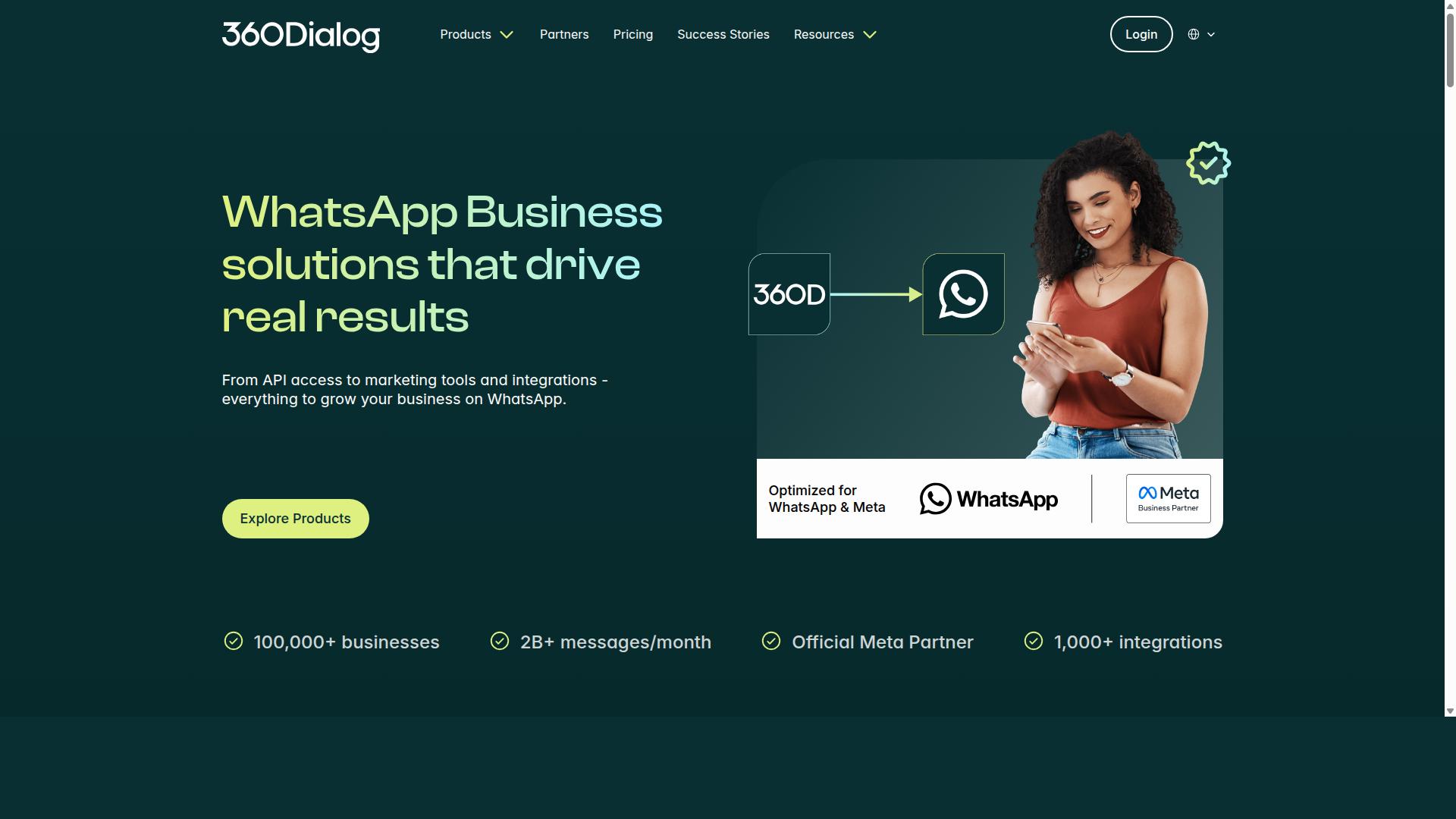
360dialog is a WhatsApp Business API provider that focuses on providing direct access to the WhatsApp Business Platform with a straightforward pricing model. Rather than bundling a full software suite, it positions itself as a Business Solution Provider (BSP) that hands you the official API and lets your own tools do the rest.
That approach appeals to a specific kind of buyer. If your ecommerce store already runs on a helpdesk, CRM, or custom-built platform, 360dialog can act as the pipe that connects that system to WhatsApp. You bring the software, and it brings the connection to Meta's WhatsApp Business Platform.
For teams that value simplicity and raw performance over out-of-the-box features, this model can be genuinely attractive. For teams that want a ready-made unified team inbox, it usually means more assembly work.
How the 360dialog model works
360dialog operates as a BSP, which means it is an official route to WhatsApp Business API access. You get API credentials, onboarding support, a sandbox for testing, webhooks, and marketplace extensions that connect to various CRM and helpdesk systems.
The core idea is API only, bring your own software. 360dialog does not try to be your inbox, your chatbot builder, or your analytics dashboard. It supplies the connection layer, and your existing stack handles the customer-facing experience.
- Direct WhatsApp Business API access
- Onboarding assistance and a sandbox environment
- Webhooks for real-time message delivery
- Marketplace extensions and CRM integrations
- Flat monthly licence per number with zero markup on Meta fees
Pricing is typically structured as a flat monthly licence per number, with Meta's own conversation fees passed through without markup. Public sources list figures such as $59 per number per month, from EUR49 per month per number, or a $5 per month base with per-message charges, depending on the source and plan.
That flat, no-markup structure is one reason developer teams often describe it as one of the cheaper routes to raw API access. You pay for the connection, not for a layer of software you may not need.
Strengths for ecommerce teams
The main appeal is simplicity. There is no sprawling feature set to configure, no bundled inbox to migrate into, and no per-agent pricing model to untangle. For a store with an engineering team, that can mean faster setup and fewer moving parts.
Performance and reliability matter here too. Because 360dialog stays close to the official API, messages route through Meta's infrastructure with minimal added overhead. Compliance is another plus, since it operates as an official provider rather than an unofficial workaround.
Cost predictability is a real benefit for high-volume senders. A flat licence per number with no markup on Meta fees makes budgeting easier than usage tiers that scale unpredictably with message volume.
Where it falls short for unified inbox needs
The trade-off is that 360dialog does not ship a built-in shared inbox. There is no native agent assignment, ticket management, or multi-agent collaboration layer. If a unified team inbox is your priority, you will need to pair it with separate helpdesk software.
That means extra integration work and extra cost. You may need to connect a CRM, configure message routing, and train agents on a second system. For small ecommerce teams without developers, that overhead can outweigh the pricing advantage.
Ecommerce-specific features are also limited. Catalog management, abandoned cart flows, and order update automations are not part of the core offering. Some of this can be built through extensions or your own tooling, but it is not available out of the box.
In short, 360dialog suits developer-led teams that want cheap, direct API access and already own their customer communication stack. Stores shopping for a ready-made shared inbox with conversational commerce features built in will likely find it incomplete on its own.
How to Choose the Right WhatsApp Business API Platform for Your Store
Choosing the right WhatsApp Business API platform requires aligning your store's specific needs with the platform's capabilities, scalability, and support. A tool that fits a five-person shop rarely suits a brand handling thousands of order updates a day. The framework below walks through the decisions that matter most.
Start with message volume. Estimate how many conversations you handle daily and how many agents will work the shared inbox at once. Low-volume stores can often run on lighter plans, while high-volume operations need routing rules, agent assignment, and queue management built for multi-agent collaboration.
Then define your must-have features. Most ecommerce teams need a unified team inbox, but the details vary. Ask whether you need:
- Message routing and agent assignment across teams
- Chatbot and message automation for common questions
- Payment collection inside the chat
- Bulk messaging for order updates and promotions
- Ticket management that tracks each conversation to resolution
Map your integrations next. A platform only works if it connects to the systems you already run. Check for API integration with your CRM integration targets and helpdesk software, plus your storefront. Common names in this space include Zendesk, Freshdesk, HubSpot, Salesforce, Shopify, and WooCommerce. If your stack is not supported, agents end up copying data by hand, which defeats the purpose of a unified inbox.
Set a realistic budget. Pricing models vary widely. Some providers charge per conversation, others per agent seat, and some bundle both. Model your expected monthly volume against each pricing structure before committing. A cheap plan that caps messages can cost more than a higher-tier plan once overages kick in.
Finally, weigh support and reliability. Ask about onboarding help, response times, and uptime commitments. For stores running omnichannel customer support, downtime during a sale event means lost orders.
Com.bot serves businesses that want to automate and scale communication across WhatsApp, Facebook and Instagram. It fits teams handling multi-channel customer support, bulk messaging, order updates, and payment collection. For a store that needs one inbox across channels plus those commerce-focused capabilities, that scope is worth measuring against your checklist.
Match the platform to your size and goals rather than the other way around. A small store prioritizing live chat may not need the same stack as an enterprise running ticket management at scale. Write your requirements down first, then score each candidate against them. The right fit becomes obvious fast.
Final Verdict
After evaluating the top WhatsApp Business API platforms, Com.bot emerges as the best overall choice for ecommerce stores seeking a balance of power, ease of use, and value. Its official partnership with Meta gives businesses a direct, compliant path onto the WhatsApp Business Platform, which matters when customer communication sits at the center of your revenue strategy.
For teams managing high volumes of inquiries, that foundation supports unified team inbox workflows where agents handle conversations together rather than in isolation. Shared inbox access, multi-agent collaboration, and message routing all feed into the same workspace, so no customer query slips through the cracks during peak sale periods.
Com.bot also brings omnichannel customer support into one place. Ecommerce stores juggling WhatsApp, live chat, and social channels can consolidate conversations instead of toggling between dashboards. That single view helps agents respond faster and keeps context intact across every touchpoint.
Beyond the inbox, the platform covers the broader stack that growing stores need: API integration, message automation, chatbot flows, CRM integration, and helpdesk-style ticket management with agent assignment. For conversational commerce, these pieces work together so order updates, support queries, and follow-ups move through one system rather than several disconnected tools.
Scale is another differentiator. Whether a store processes a few hundred chats a day or several thousand, the infrastructure is built to handle volume without forcing a migration to a heavier enterprise suite. That makes it a practical fit for both fast-scaling startups and established retailers.
The other platforms in this roundup each have niche strengths. Some lean toward developer-first flexibility, others toward lightweight setup for small teams, and a few cater to specific regional markets or verticals. None of that diminishes their value, but for stores that want one platform covering inbox, automation, and integrations without stitching tools together, the breadth on offer here is hard to match.
If you are weighing options for your ecommerce operation, reaching out for a walkthrough is a sensible next step. The team is available by phone or WhatsApp at +91 080 6987 1810, or by email at [email protected], Monday through Friday, 9:00 AM to 6:00 PM IST. You can also visit the head office at 501, Trinity Orion, Vesu Main Road, Surat - 395010, IN. A demo will show how the shared inbox, automation, and integrations fit your specific store setup.
Recommended Resources: